
What if anyone could become a millionaire trader — not by watching the markets all day or mastering complex indicators, but simply by following a set of rules?
In the early 1980s, two traders decided to put that idea to the test. What happened next became one of the most legendary and surprisingly under-the-radar stories in trading history: The Turtle Trading Experiment.
It turned everyday people — with no trading experience — into market-beating professionals. The group collectively generated over $175 million in just a few years.
And here’s the kicker: the system they used? It still works today.
Let’s dive into how it all happened — and how the same strategy is being revived for modern traders.
The Debate That Started It All
In the early ’80s, Richard Dennis, a successful commodities trader, was having an ongoing debate with his partner, William Eckhardt.
- Dennis believed that great traders could be made — that with the right system, anyone could succeed.
- Eckhardt thought trading success came down to natural talent and intuition — something that couldn’t be taught.
To settle the debate, Dennis proposed an experiment: recruit a group of people, teach them his trading system, and give them real money to manage.
The results would speak for themselves.
Enter the “Turtles”
Dennis placed ads in major newspapers, inviting applicants from all walks of life. From more than 1,000 applicants, he selected a small group: teachers, musicians, engineers — people with no prior trading experience.
They were given two weeks of training.
The rules they learned formed a mechanical trend-following system — now famously known as the Turtle Trading System.
Why the name “Turtles”? Dennis was inspired by turtle farms he had seen in Singapore, confident he could “grow traders just like they grow turtles — quickly and in batches.”
Each recruit was given an average of $1 million (varied by turtle) in capital to manage, using only the rules they had been taught.
Over the following four years, the group reportedly generated over $175 million in profits, and an average annual return of over 80%.
The Rules Were Simple — But Powerful
The Turtle system wasn’t based on market predictions or news events. It used a set of mechanical rules designed to exploit trending markets and minimize emotional decision-making.
The core components:
- Breakout entries: Buy when price breaks above a recent 20 or 55-day high.
- Volatility-based position sizing: Use Average True Range (ATR) to scale exposure based on risk.
- Pyramiding: Add to winners as the trend continues.
- Trailing exits: Exit when the trend breaks down (e.g., new 10-day low).
No hunches. No gut calls. Just math, risk control, and patience.
We recently broke down the logic behind these rules and why they’re still effective today in this article: Is the Turtle Trading System Still Relevant in Today’s Markets?
The specific details of the strategy are included on this page describing the Turtle Trading Strategy in detail.
Why It Still Works Today
You might wonder — could something this simple still work in 2025?
Yes. In fact, it might be even more valuable now.
While the markets are faster, noisier, and more automated than ever, human behavior hasn’t changed. Fear and greed still drive price movement. Trends still form and dissolve in predictable ways. Most traders still lack the consistency to follow a system through.
That’s where the Turtle system shines.
It’s not trying to predict where the market goes next — it just reacts to what’s happening, and does so with disciplined risk management.
If you want to understand how consistency plays a bigger role than prediction, check out this article on How a Consistent Trading Strategy Leads to Trading Success.
Real Example: The Turtle Signals Still Work
Want proof that this system still holds up?
In late 2024, our platform — TurtleSignals — generated a long signal for United Airlines (UAL) using the exact Turtle system logic.
The trade entered at $43.66 and exited at $95.29 over a 15-week hold. The result?
A +118% return from a single breakout, risk-managed trade.
You can read the full breakdown here: The Turtle Trade That Doubled Our Money in 15 Weeks
Bringing the Turtle System to Modern Traders
There’s just one catch: while the Turtle strategy is simple in theory, it can be challenging to manage manually.
- Tracking breakouts across dozens of tickers
- Calculating position sizes based on ATR
- Pyramiding entries at the right moment
- Sticking to the rules under pressure
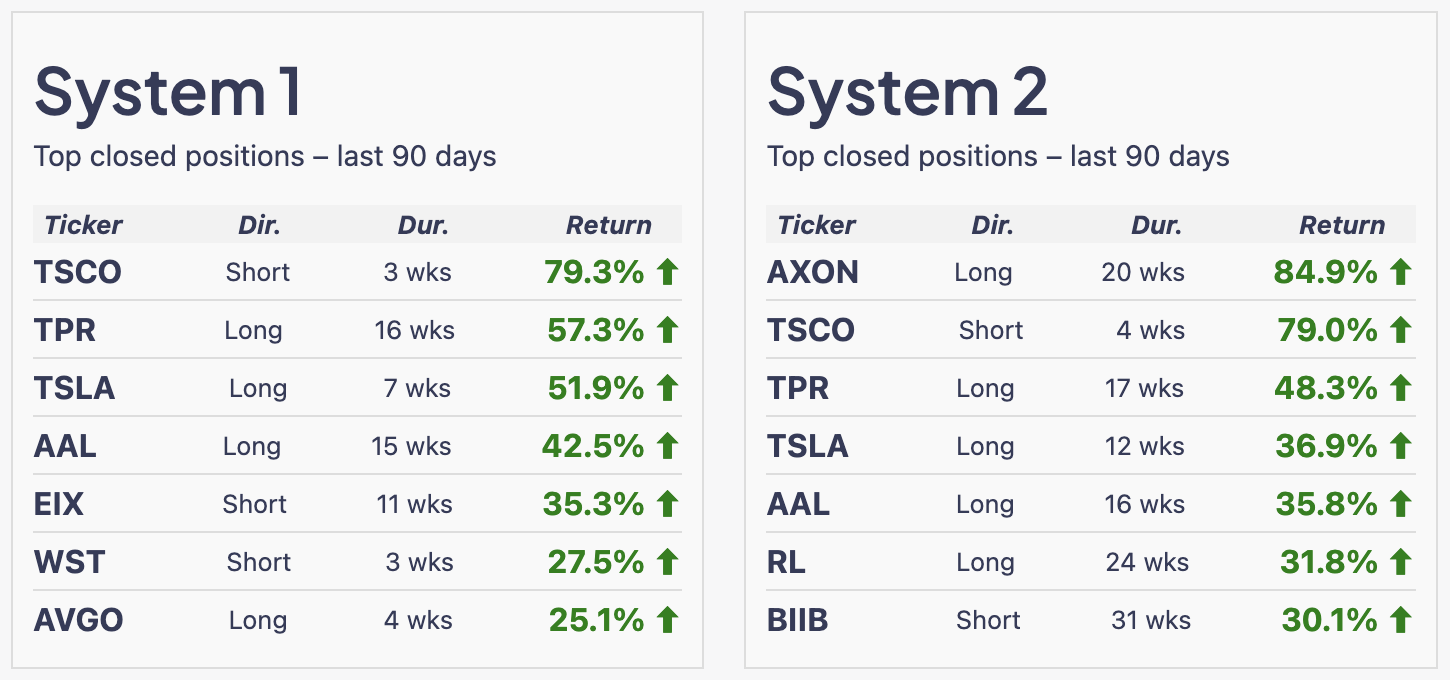
That’s why we created TurtleSignals — to automate this exact strategy and make it accessible to everyday traders.
We scan the markets, run the math, and deliver real-time signals to a private Telegram group, so you can focus on execution and not get bogged down in analysis.
Experience clarity and confidence with TurtleSignals, where every signal is based on a tried-and-true system.
Final Thoughts: Discipline Never Goes Out of Style
The Turtle Trading experiment proved that with the right system and discipline, trading success is teachable.
What started as a bold bet between two traders ended in one of the greatest trading success stories of all time — and the same system they used is still catching big moves today.
You don’t need to be on Wall Street to be successful trader.
You just need a process that works — and the discipline to follow it.
Sign up to our newsletter to get similar articles delivered to your inbox.


Leave a Reply