
In a world of high-frequency trading bots, real-time news sentiment analysis, and AI-powered algorithms, it’s fair to ask: Can a trading system designed in the 1980s still work today?
The Turtle Trading system — created during a famous experiment by Richard Dennis and William Eckhardt — turned complete novices into millionaire traders using nothing more than a rule-based trend-following strategy. Forty years later, the markets have evolved — but have the core principles of successful trading really changed?
Let’s explore what the Turtle system is, why it still works, and how modern tools like TurtleSignals make it more accessible than ever.
What Is the Turtle Trading System?
The Turtle Trading system was born out of a debate between two legendary traders: is great trading talent innate or teachable? Richard Dennis believed anyone could learn to trade with the right system — so he put that theory to the test by training a group of total beginners, known as the “Turtles.”
They were given a strict set of rules: enter on price breakouts, size positions based on volatility, pyramid into winning trades, and cut losers quickly. No gut feelings, no news watching — just mechanical, rules-based execution.
The results? The Turtles collectively made over $175 million in profits in just a few years.
How the System Works — Simple and Systematically
At its core, the Turtle strategy is a trend-following breakout system. It looks for strong directional movement and rides the trend until momentum fades.
Here are the key mechanics:
- Entry: Buy when price breaks above a recent high (e.g., the 20-day or 55-day high); sell/short when it breaks below a recent low.
- Position Sizing: Use Average True Range (ATR) to adjust position sizes based on volatility, maintaining consistent risk.
- Pyramiding: Add to winners as the trend continues — one of the secrets behind large returns.
- Exit: Close the trade when price breaks the opposite side of the range (e.g., the 10-day or 20-day low on a long position).
These rules form a systematic approach that removes emotion, second-guessing, and overtrading — three of the biggest killers of trading performance.
But What About Today’s Markets?
It’s true: markets today move faster, react to headlines instantly, and are influenced by complex institutional flows. So does an “old-school” system like Turtle trading still stand a chance?
Yes — and here’s why:
- Turtle trading isn’t built for speed; it’s built for trends. It operates on daily timeframes and targets medium- to long-term price moves. This makes it mostly immune to the noise of intraday fluctuations or high-frequency trading algorithms.
- Human behavior hasn’t changed. Herd mentality, fear, greed — these are still the driving forces behind most market trends. The Turtle system exploits these emotions by buying breakouts when others hesitate, and holding winners when most would sell early for quick but lower profits.
- Rules-based trading is more valuable than ever. In a noisy, over-stimulated market, the discipline of following a proven system provides clarity and consistency.
That said, the system isn’t perfect for every asset. Highly correlated instruments like cryptocurrencies may not provide the diversification the system needs to manage risk effectively. But in traditional markets — equities, commodities, currencies — the Turtle strategy continues to shine.
Case Study – UAL : +118% Return in 105 Days
Let’s take a look at a recent real-world signal from TurtleSignals on United Airlines Holdings (UAL).
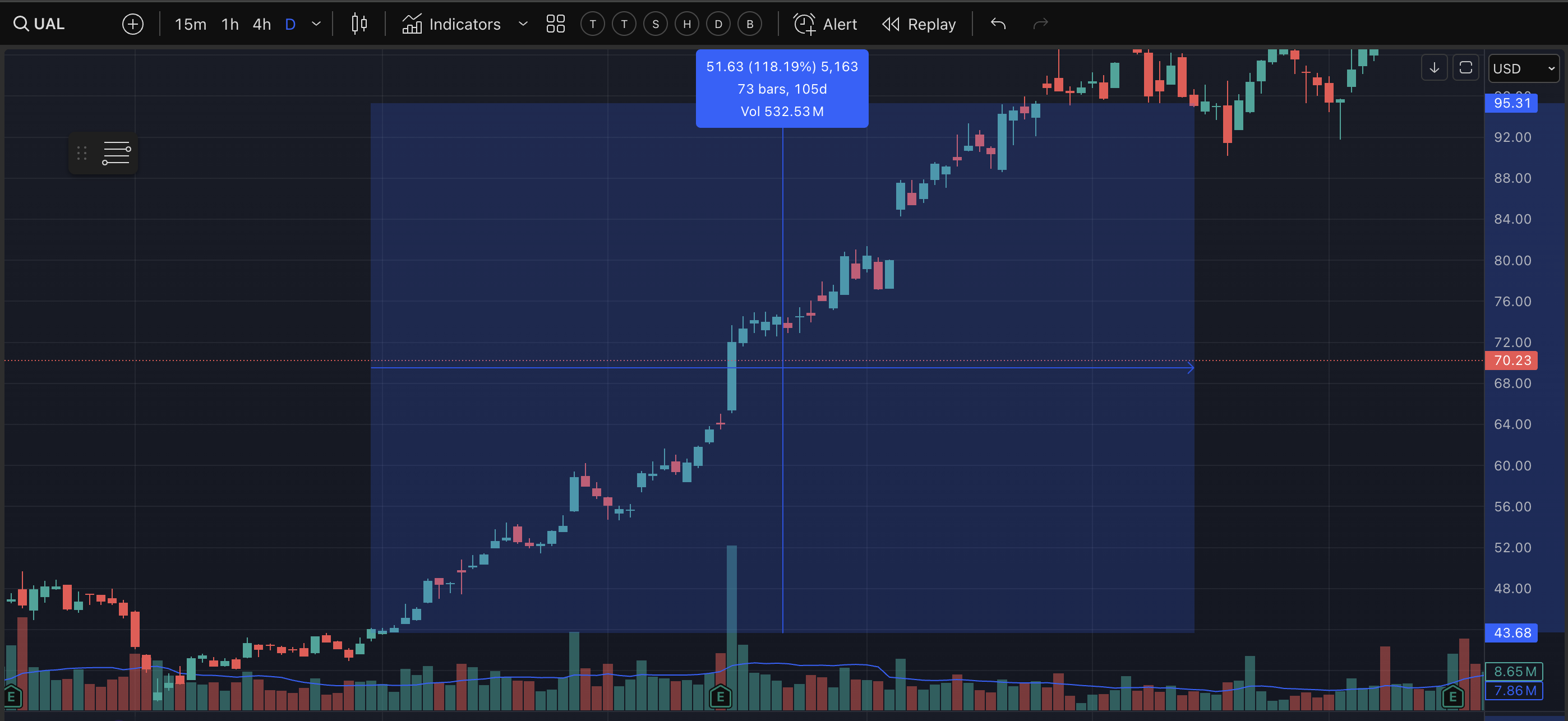
On August 30th, 2024, the system triggered a long entry at $43.66, following a classic breakout from consolidation. Over the next three months, UAL steadily trended higher, allowing for pyramiding opportunities and trailing stop adjustments as the trend matured.
Eventually, a sell signal was triggered on December 13th, 2024, at $95.29 — locking in a +118% gain in just 105 days.
This trade followed the Turtle principles to the letter:
- Disciplined entry on a clear breakout.
- Volatility-adjusted position sizing.
- Letting the trend run — without trying to predict the top.
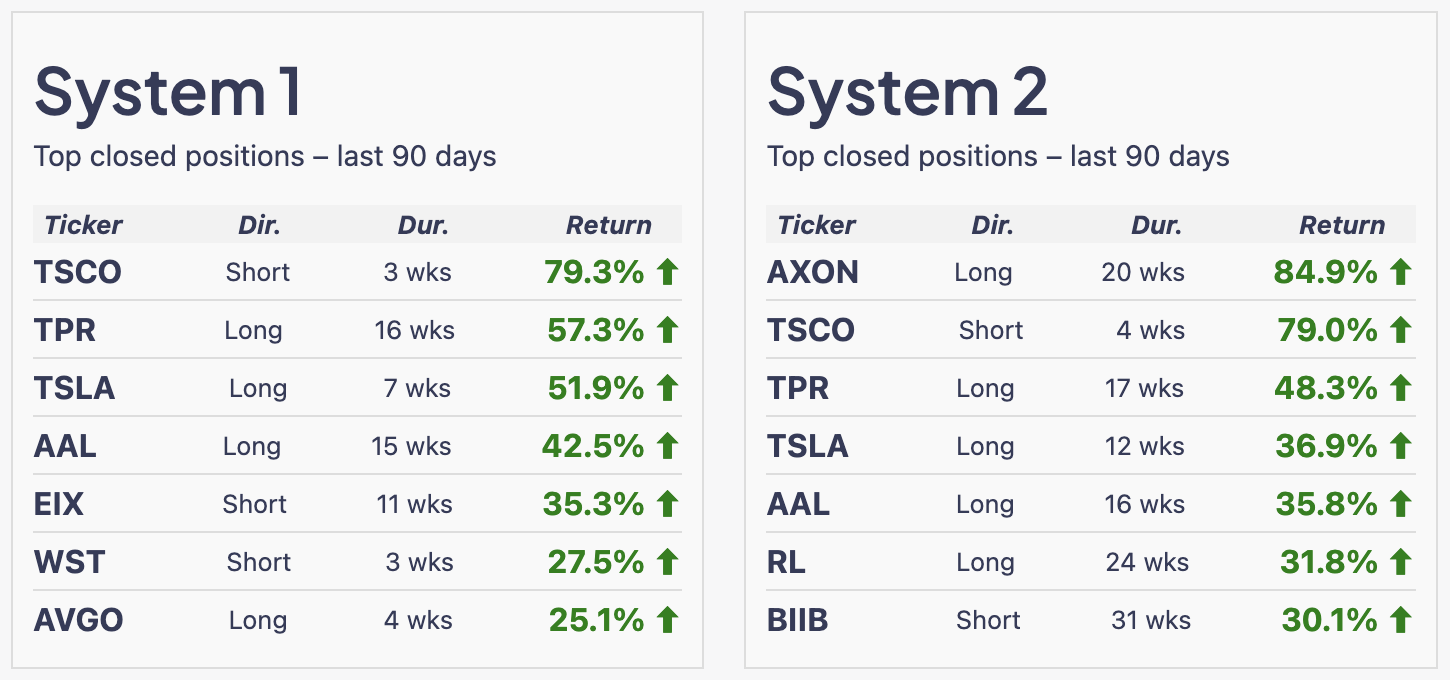
These are exactly the kinds of setups TurtleSignals continuously scans for across the market. As of today, the returns of the top profit trades from the last 90 days based on the signals:
Why the Turtle System Still Works
The markets may be faster, flashier, and full of distractions, but some things haven’t changed:
- Trends still occur.
- Most traders still lack discipline.
- Emotions still cloud judgment.
That’s where the Turtle system — and TurtleSignals — give you an edge. By sticking to time-tested rules and avoiding knee-jerk reactions, traders can stay on the right side of big moves and avoid death by a thousand cuts.
Want to Trade Like a Turtle — Without the Spreadsheets?
If you’re curious to see how the Turtle strategy works in real time, TurtleSignals delivers signal alerts based on the exact principles used by the original Turtle traders — optimized for today’s market conditions.
No guesswork, no manual calculations. Just clean, rule-based trade alerts.
Conclusion
The Turtle Trading system isn’t just a relic of trading history — it’s a timeless reminder that discipline beats prediction. While markets may evolve, the need for a structured, risk-managed trading approach never goes out of style.
And thanks to platforms like TurtleSignals, you don’t need to be a millionaire hedge fund trader to benefit from one of the most iconic trading systems ever created.
Sign up to our newsletter to get similar articles delivered to your inbox.


Leave a Reply